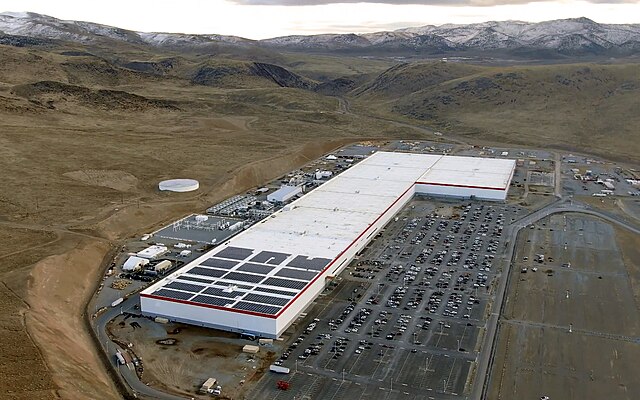
The expression “Gigafactory” was coined by Elon Musk in 2013, when he announced Tesla’s plan to build an unprecedented large-scale lithium battery manufacturing plant in Nevada. The plant was needed to meet production targets for Tesla’s first mass-produced all-electric passenger car, the luxury Model S, which would later be followed by the more affordable Model 3.
It was giga indeed. The factory would employ over 7000 people at full production (2017/2018), producing up to 35 GWh of batteries annually, which corresponds to about 500,000 electric vehicles (EVs). In comparison, General Motors (GM) built in total 1,117 EV1 during 1997-1999. (The EV1 cars were not sold but only leased for a limited time. EV1 used lead acid batteries and later nickel metal hydride (NiMH). Lithium batteries were not available at that time.)
Creative Commons Attribution. Share Alike 4.0
“Everybody” loved Tesla’s concept of building a gigafactory for batteries. It demonstrated Tesla was serious about taking EVs to a step-function higher level. Customers, in large numbers, paid deposits to get in line for deliveries. Investors found Tesla with its clear leadership position and with the projected strong growth attractive to invest in, even though the company was not profitable. For the green energy transition advocates Tesla/Elon Musk became the hero, initiating and enabling the transition to electric cars.
Many politicians loved the gigafactory concept. A large greenfield factory, many new “green jobs”, and that it could be built fast, already during the politician’s mandate period, was much more appealing than dealing with several small companies, out of which many would fail. However, ignorance of what it would take, and/or arrogance about the strength of the Asian battery companies created an environment, where risks were downplayed, and the confidence in the domestic capabilities was overstated. It added up to what can be called The Gigafactory Syndrome.
In fact, Tesla could substantially leverage the attraction of the planned gigafactory. Several states wanted Tesla to build the batteries in their state. Eventually Nevada won thanks to less regulations and large subsidies, estimated to be worth close to $1.3 billion.
Gigafactory became a buzzword around the world, not least in Europe. EU identified lithium battery manufacturing as strategic. They saw it crucial for the European car makers to compete in the expected boom of EVs. The European Battery Alliance was formed in 2017. Together with the European Investment Bank (EIB) they set aside €1.7 billion in grants and loan guarantees for battery research and manufacturing to support building a “domestic” European battery industry.
Generous EU subsidies, favorable loans from EIB (European Investment Bank) and others reinforced by national roadmaps in Germany and Sweden, sparked a wave of European lithium battery start-ups. The largest and most ambitious was Northvolt, founded in October 2016. Northvolt was well capitalized through equity, from investors like VW and Goldman Sachs as well as pension funds, and debt financing, backed loan guarantees. It enabled Northvolt to set its sights high: building three gigafactories in Sweden, two gigafactories in Germany, and later one in Quebec, Canada.
What could go wrong? If Elon Musk could do it in the US, Peter Carlsson—Northvolt’s co-founder and CEO, who had worked for Musk at Tesla from 2011 to October 2015—convinced politicians, investors, and customers that Northvolt could not only build competitive lithium battery cells in Europe but produce the “greenest battery cells in the world.” Lower electricity costs from renewable energy and control over the entire supply chain, he argued, would make it all possible. It was a compelling vision, but not one anchored in reality.

CC BY-SA 4.0 by Spisen.
In 2018 Northvolt broke ground for its first gigafactory, Northvolt Ett, in Skellefteå, Sweden. Six years later (2024) Northvolt filed for bankruptcy. The failure was spectacular, about $8 billion in debt. The very few battery cells produced in Northvolt Ett, used cathode material, the key component in a lithium battery cell, from China. The gigafactories in Germany and Canada were only in early stages of construction. The planned gigafactory in Borlänge had been terminated even before the construction of the plant. The same status for the joint venture with Volvo with a planned factory in the Gothenburg area. Ironically, the only people who seemed to have made money were Peter Carlsson and his management team, as well as the consultants, who had advocated for and promoted the project!
Northvolt was the biggest failure but not the only one. Far from it. The list of failed lithium battery initiatives in Europe includes companies like Freyr, Morrow, Ioncore, Nilar and Britishvolt. Europe was not unique. In the US the Biden Administration through the Investing in America Agenda and other programs offered generous support to companies building new battery plants in the US. Domestic start-ups like 24M Technologies, Ascend Elements and Natron Energy all failed.
What went so wrong? A major factor seems to have been the perception that Tesla had built their gigafactory more or less from scratch. It was not the case. On the contrary, it was Tesla’s main battery cell supplier, Panasonic, who had scaled their existing production in Japan to the gigafactory in Nevada. In fact, Panasonic has about 2/3 of the floor space in the gigafactory, building the battery cells. In the other 1/3 of the building Tesla builds the battery packs. Panasonic invested $1.6 B for its part of the gigafactory. The gigafactory had the Tesla name on the building but inside it was Panasonic who built, owned and operated the battery cell production lines.
It had taken decades for Panasonic to build and accumulate the knowledge, know-how and skills to produce lithium battery cells, starting small and by continuous improvement gradually scaling production. Northvolt and the other failing companies seriously underestimated this fact. Instead, they tried to build their respective gigafactories from scratch without prior knowledge. In Northvolt’s case, they tried to do it with a “foreign legion” of newly recruited employees from over 100 countries. Further, trying to accelerate the process Northvolt even skipped the factory acceptance test of the core production lines they had purchased from Wuxi Lead in China.
What was true for Panasonic can also be said for the Korean companies, LG Chem, SK On and Samsung, and for the Chinese companies, CATL, BYD and many more. Consequently, it should not come as a surprise that these companies have been successful also in setting up battery gigafactories in the US and Europe, both directly as well as through joint ventures.
The only domestic company in the US or Europe that has managed to make commercial grade lithium battery cells so far is PowerCo, a dedicated battery company VW launched in July 2023, but already in March 2021 VW had bought out Northvolt from the joint venture with its planned Northvolt Zwei factory in Salzgitter, Germany,where VW have operations. It meant near access to skilled engineers and workers. In addition, VW had in 2020 acquired a 24% stake in the Chinese battery company Gotion for $1.2 B. The stake was later expanded to 26%, making VW the largest shareholder. Gotion’s proven battery cell competence became the foundation for the factory PowerCo started to build in Salzgitter. In December last year (2025) Power Co announced that the battery cell factory had been commissioned. The factory will now gradually scale up to 20 GWh. Additionally, PowerCo and Gotion is building a gigafactory in Valencia, Spain, and announced plans for a gigafactory in Surany, Slovak Republic, and a production facility for LFP (lithium iron phosphate) cathode material in Kenitra, Morocco.
For politicians driving the “Energy Transition” new gigafafactories will remain very attractive, but hopefully lessons have now been learnt from the battery cell manufacturing attempts. Gigafactories for batteries cannot be built from absolute scratch. Instead, it is crucial for success in North America and Western Europe to have transfer of technology through joint ventures and/or licenses, and/or other forms of cooperation from/with the leading battery cell companies in China, Korea and Japan.